Sunday 02nd April 2023

Palm Sunday of the Lord’s Passion Year A 

Matt. 21:1-11; Is. 50:4-7; Phil. 2:6-11; Matt. 26:14-27, 66

Fr. Dufe Joseph OFM Cap.

This is the Sunday on which the great door of the Holy Week opens before the life of every Christian. With today, time truly becomes shorter, and the disciple is called to follow the Lord Jesus as he enters Jerusalem at a faster pace. On the one hand, standing aloof, like a spectator will render us similar to those who were mocking at him. On the other hand, identifying with Christ’s disciples can certainly help us understand what today’s liturgy invites us to contemplate. They, like the inhabitants of the Holy City, had witnessed the miracles that Jesus had performed in the previous days and how the one whom they had been following with interest for months had even raised a man, Lazarus of Bethany, from the world of the dead. If at one time, on hearing Jesus’ purpose of going to Jerusalem, they had felt fear and bewilderment, now guiding their steps was the exhilaration that pervaded the feeling of people amazed at the fulfillment of the promises revealed by the Prophets.

But the mood, we have just heard, is soon destined to change, and the messianic title of “son of David”, though unveiled in its real scope as “King of the Jews”, will soon become a cause for ridicule by the soldiers. There is a very interesting change of behavior here. It starts from exhilaration with the Hosanna, then shifts to mockery, reaches the worse phase in the crucifixion, and then returns to exhilaration again with the Easter Alleluia. This is real pedagogy for us. If we learn something from this, then we can easily face life’s situations, since this is the same pattern that daily life follows. And we will never fall into despair. The Lord Jesus, even in the darkest hour of the most excruciating agony, while abandoned by all, does not give in to the temptation to abandon the cup that the Father desires him to drink. On the contrary, it is precisely at that moment that what the prophet Isaiah had foretold in one of the four Servant-Songs, proposed in the first reading, becomes relevant: in it, therefore, emerges the style that each of us should assume: “Every morning you open my ear that I may listen”. “Listening,” for the Semitic peoples, is no different from “following”. And it is precisely the theme of “following” that is like the red thread that binds all the passages of sacred Scripture we have heard today, making them impinge in our personal and communal lives. We are talking about a following that, when it is not denied, as in the case of the disciples who forsook him and fled, becomes an unmistakable sign of love for God the Father, the only way to truly love one’s brothers and sisters.

It is only through this “following Christ” that our redemption is brought about: the life of the Lord Jesus was all defined by listening to the will of the Father. We should not be surprised, then, if the Church also offers us one of the oldest passages that speak of Jesus, a passage from the Letter to the Philippians, that in six verses succeeds in drawing before us the life of Christ through the trait of obedience. There is no other way but for us to enter into the contemplation of these Passion days through “following the Lord”. Let us live these days by seeking his presence in the folds of our history – at work, in the family, with friends. Let us follow him through the streets of Jerusalem, taking care to return to him, precisely because during this week we will realize that we have betrayed him, abandoned him and lost sight of him. Let us go up with him to Calvary and, like the Centurion who had previously mocked him, ask that his total abandonment to death on the Cross enable us to recognize him as the One who alone can change our lives. Yes, at the end of Holy Week, let us confess that “truly this was the Son of God”.

Sunday 26th March 2023: 5th Sunday of Lent Year A 

Ez. 37:12-14; Rom. 8:8-11; John 11:1-45

Fr. Dufe Joseph OFM Cap.

Of all the miracles Jesus worked, the raising of Lazarus ranks as the most astonishing to the people of his time. Traditional Jewish belief had it that the soul of a dead person somehow remains with the body for three days. After three days the soul departs finally from the body never to return, and that is when corruption sets in. When Martha objects to the opening of the tomb and says, “Lord, already there is a stench because he has been dead four days”, she is expressing the common view that this is now a hopeless situation. G.K. Chesterton once said, “Hope means hoping when things are hopeless, or it is no virtue at all.” In traditional Jewish mentality bringing back to life a person who was already four days dead and decaying was as unthinkable as the prophet Ezekiel’s vision in which the grey, dry bones of the dead are miraculously restored to life. For the early Christians this story of the raising of Lazarus was a pointer to the resurrection of Jesus. Jesus rose on the third day; his body never saw corruption even if it reached the third day – the day of corruption and of vital impossibility. For us this miracle is a challenge to never give up hope even in the hopeless situations in which we find ourselves as individuals, as a church or as a nation. It is never too late for God to revive and revitalize a person, a church or a nation. But first we must learn to cooperate with God.

At such a time, when hope seems to be hopeless, our faith is the only thing we can hold onto. In the gospel of today there is no one in the story, not even Mary or Martha, who believed that Jesus could bring Lazarus back to life after four days dead. The faith here is not the cabbage type of faith that some of us live. Rather the emphasis in the story is on how we cooperate with a miracle-working God; the emphasis is placed on practical obedience and doing God’s will. To do God’s will, we must first love the will, love God and love our neighbor. Now you can see how the three theological virtues interplay. You cannot hope for what you hate, and while hoping you must continue to practice your faith. To effect the miracle, Jesus issues three commands and all of them are obeyed to the letter. That is how the miracle happens. First, Jesus says, “Roll away the stone”, and they do it. Of course during his own resurrection the stone will be rolled miraculously and by no person of flesh. We may ask in the case of Lazarus: did the people understand why they should do this heavy work of rolling away the tombstone to expose a stinking corpse? You bet they didn’t. But it was their faith in Jesus, expressing itself not through intellectual agreement with him but through practical agreement with him, through obedience. Why didn’t Jesus command the stone to roll away all by itself, without bothering the people? Why did he not, as some said, prevent the death of his friend? We don’t quite know. All we know is that divine power seems always to be activated by human cooperation, yet stifled by non-cooperation. God’s miracle comes in only when we would have done our own part. He needs the two fish and the five loaves in order to perform the miracle of multiplication. We need bread and wine in order to celebrate the Eucharist. Yet, it would be absurd for us to command God to do things we can do ourselves, like feeding the hungry and housing the homeless.

The second command which Jesus gives is directed to the dead man: “Lazarus, come out!”, and the dead man came out. We do not know the details of what transpired in the tomb or what conversation went between Jesus and Lazarus in the innermost of their beings – of course, we never know what goes on inside friends, even when we pretend to claim the knowledge. But all we know is that Lazarus, whom people had considered food for the worms, did obey Jesus and did come out. From this, we know that Jesus’ word of command is followed by immediate obedience. Jesus is Lord, both of the living and the dead. Lazarus gropes his way out of the dark tomb, even with his hands and feet tied up in bandages, and his face all wrapped up – yet he still can see his way out of the tomb. Here we see that even a man rotting away in the tomb can still do something to help himself; a man blinded by human agents can still see through the band that ties his face. No matter how deep you think you have been buried by your troubles, no matter how deep you think you have been in shit, at the command of Jesus, there is still hope. What is more difficult to do, to come out from the grave or to unbind oneself? Certainly the former, but Jesus still asks help for Lazarus in the latter. He continues to ask you to one more time help those whom you think you have helped already.

The third and last command again is addressed to the people, “Unbind him, and let him go”. If Lazarus could stumble himself out of the tomb with his eyes tied, there was no way he could unbind himself. Some obstacles are more than others. By unbinding Lazarus and setting him free from the death bands, the community is doing their own part in accepting Lazarus back as one of them. How often do we bind off people from our lives and declare that we have nothing to do with them. Figuratively we bind them in the tombs we have built for them. We roll heavy stones over their graves and go on with life as if those people never existed in the first place. What should have been the reason for binding someone before burying? Probably it was due to the fear that he could still come back to life, and maybe cause havoc. In Jesus, physical binding is nothing. He can simply ask us to do the unbinding. What is heavy, and which he alone can do is spiritual unbinding – giving back spiritual life. That is what he asks from us today as we meditate on the resurrection of Lazarus. No matter what you are going through at the moment, if we remain faithful to God, dry bone will live, life will come back.

Saturday 25th March 2023
The Annunciation of the Lord Year A
Is. 7:10-14; 8:10; Heb. 10:4-10; Lk. 1:26-38
Fr. Dufe Joseph OFM Cap.

The discussion between the Angel Gabriel and Mary stands at the root of our redemption. In fact, if the terms had not been agreed upon right there at the start, our story would not have been what it is today – we would have been telling it in another way which we cannot even imagine now.

This encounter between the Angel and Mary is thus a very decisive moment because the decision of Mary is determinant in the evolution of human history. Through Mary, God enters into the human story in a particular way, and since then things would not be the same again. Though this event had long been prophesied through Isaiah in the encounter between Ahaz and the Lord, Mary still had to use her own free will in order to access this divine realm. Isaiah had earlier prophesied that “the virgin shall be with child, and bear a son, and shall name him Emmanuel, which means ‘God-with-us!’” When the prophecy was about to be fulfilled the Angel said to Mary: “Do not be afraid, Mary, for you have found favour with God. Behold, you will conceive in your womb and bear a son, and you shall name him Jesus”. Quite often we allow fear to overtake and engulf us away from the divine plan in us.

The coming of Jesus into human history is the coming of God among men in a particular way. In Jesus the rule of God among men has been inaugurated and it will have no end. According to the author of the Letter to the Hebrews, upon coming into the world Christ declared: “Behold, I come to do your will”. Because of this he made it clear that his food was the doing of the will of the Father. This, he reminded his parents at the age of twelve, when they went searching for him and found him in the temple. The Church, consecrated through the offering of the Body and Blood of Jesus Christ, continues to offer this sacrifice by which the will of God is fulfilled among men. It is this sacrifice that we offer today as we celebrate the Solemnity of the Annunciation, that event by which Mary, for the first time, experienced the love of God in a special way; being favoured, she was entrusted with the huge task of co-operating in the redemption of the world. This event challenges us to review our own personal mission – our own cooperation. Do we have any mission at all? And if we do, how are we working at realizing it? We do realize that the words of Mary to the Angel were mostly in the interrogative. Yes! It is only at the end that she affirms the decision of God with the following words: “May it be done to me according to your will”. And that is the moment the angel left her. We still have the angel with us as we move towards complete holiness; he has not yet left us. Let us continue to ask our questions of faith and to put on every effort we have in our mission. From time to time let us revise what we have done and see if we still have more questions to ask the angel. In order words, let our prayer be the support of our missionary work.

Solemnity of St. Joseph, Husband of the BVM

Fr. Dufe Joseph OFM Cap.

2 Sam. 7:4-5, 12-14, 16; Rom. 4:13, 16-18, 22; Matt. 1:16, 18-21, 24

This year the Church has shifted the celebration of the Solemnity of St. Joseph from 19 March to this Monday so as not to interrupt the Sunday liturgy and thus preserve the Lenten journey that we have been observing. The father figure of Joseph keeps coming to mind at an era where the same figure in our society is being put into question, especially by some modern medical technological measures whereby a lady can just walk into the hospital and ask to me made pregnant through seminal injection, with sperm gotten from someone whom they do not care to know, and whom the child will never know. Furthermore, Joseph stands as a figure of defence in the same society which offers death of woman and/or child as the solution to what has commonly become known as “unwanted pregnancies”. In the first case, no one cares to know the father of the child. In the second case, the father is known but his identity is hidden, so the elimination of the child becomes the immediate solution.

A journey through the bible tells us that not so much is said about this man, Joseph. In fact the gospel of Mark has just no mention of his name at all. John mentions the name only 2 times, and in doubtful negative situations: “Philip found Nathanael and said to him, ‘We have found him of whom Moses in the Law and the prophets wrote, Jesus son of Joseph, from Nazareth’” (John 1:45-46). This means that Joseph cannot have such a son. In the second instance they are actually admitting that Jesus is the son of Joseph but doubting the son’s divine nature. The Jews “were saying, ‘Surely this is Jesus son of Joseph, whose father and mother we know” John 6:41-42. On the other hand Matthew mentions Joseph’s name 7 times and Luke 5 times. Even as such, none of them gives any details. There is no mention of his place and date of birth, and worst of all, he is not said to have ever mentioned a word – one retreat mistress has said that “Jesus” is the only word of Joseph.

The members of the great association known as the Catholic Men’s Association (CMA) great each other thus: “St. Joseph, man of honour, pray for us”. This greeting is drawn from the Gospel text of today, which is one of the references of Matthew. There are 6 qualities that make Joseph a man of honour, and which we are invited to imitate: 1) Sparing other people’s publicity. There is a strong tendency in us to rejoice at talking about the faults of others thus exposing their faults to the world; 2) Listening to God: many of us find it difficult to obey God in the face of social pressure such as the one that Joseph found himself in; 3) Obedience: after listening to the word of God, the big challenge is to put it to practice; 4) Putting the word of God in practice: Joseph dutifully gave the name that the angel instructed when finally the child was born; 5) Responsible Parenthood: Joseph remained close to his wife and child, especially during the flight to Egypt and when Jesus got missing in the temple. Many men feel that fatherhood ends at reproduction; 6) Silent Listening: so many of us talk so much that we find it hard to listen to our interlocutor, especially when we have taken a few cups of alcohol. Talking too much cheapens the value of words because in the end, supply is always more than demand.

These qualities, and more, made Joseph to stand out as a shining example of an honourable man. Yes, honour is earned and not bought nor inherited; this happens when we live a virtuous life. As man of honour, Joseph was a man of virtue; he put together all the theological and cardinal virtues and lived them: he loved, lived in faith and hoped; he was prudent, just, temperate and courageous, and went just for what matters, the details. The name Joseph means “God adds”. Through his cooperation with the divine plan, God added another person into humanity, the person who was to change the history of the world. A man wrote a book and gave the title: “How to change your wife in 30 days”. By the end of one week he had sold 2 million copies. He later on discovered that he had made an error. He decided to correct the title: “How to change your life in 30 days”. For the next one month he sold only 3 copies. When it comes to changing other people’s life we are experts. But when it comes to changing ours it becomes a problem. Joseph would have loved to change the life of his wife, were he in our shoes, but he rather changed his own life and his plans to suit that of God, and took Mary into his home. This is a great act, it is his own “Yes” which perfectly married the great “Yes” of his wife, and which changed the course of history. Each and everyone of us can change others, we can change the whole world, but only if we each change our lives. Let us pray, on this solemnity of St Joseph, that God may give us a little of the spirit of Joseph, this great man of honour.

4th Sunday of Lent Year A

1 Sam. 16:1-13; Eph. 5:8-14; John 9:1-41

Fr. Dufe Joseph OFM Cap.

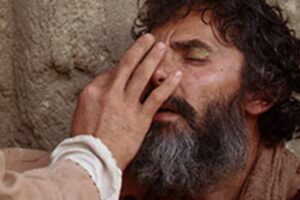
God does not see as man sees; man looks at appearances but the Lord looks at the heart. What a challenge to us! This is the message from the first reading, which leads to the anointing of David as the king of the people of Israel. This message makes us appreciate the reason why Jesus did not allow himself to be defeated by the tricky question of the disciples concerning the blind man – as to who sinned in order to have provoked blindness in him. Even after being cured, the controversy did not stop. There were doubts right from his own neighbours as to whether this was the same man who was blind or this was another person. People had believed that since he was born blind he was destined to live and die blind – a kind of compartmentalisation that most of us are guilty of. This is how man thinks, yes, and not how God thinks. In fact, the controversy even included Jesus, as to whether he could be from God or was he some kind of sinner, infringing on the Sabbath – this was the confusion among the Pharisees to whom the cured man was taken.

In a way, the Liturgy of the Church, on this Fourth Sunday of Lent, known as the Laetare Sunday (Joyful Sunday) invites us to retrace one of the fundamental dynamics of our baptismal rebirth, which is the passage from the darkness of sin and error into the light of God, which is the Risen Christ. This is the experience of man who suddenly finds himself cured of his blindness. Already in the Old Testament Revelation, as seen in the anointing of David, the Lord God had shown the People of Israel how much the Creator’s judgment was deeper and truer than the thoughts of the creature. The Lord had thus indicated what the only true criterion for judging a man was, and where man could meet God’s gaze and enter into relationship with him. This place is the heart. By “heart,” of course, the Bible does not mean the center of the innermost drives or the organ that regulates blood flow in the organism-man, but man’s “sacrarium,” his conscience, where he is given the possibility to listen to the very voice of God and recognize it, and so produce the effects of the light which are complete goodness and right living and truth – no matter what others think.

However, unable to remain faithful to what is truest in him, man reverts back to his own petty criteria, producing every wickedness, injustice and falsehood, in order to govern himself, obtaining what, from time to time, he decides to be his good, and hoping to become thus “like God”. God, however, does not give up. He comes to each of us in the twofold way narrated by the Gospel. First, he does so through sacramental signs just as in the ritual performed by Jesus on the blind man. He cleanses us and then places us on the second pedestal, which is that of mission. Siloam is a pool which name means “sent”. We are not sent until we have been made clean. The cleansing process is a very difficult process, but we must go through it if we are to be who we are called to be, not blind people but people of light. Christ, sent by the Father, takes upon himself all our sins, even to the ultimate consequences of our blindness, right to the point of allowing himself to be stripped naked, crowned with thorns and nailed to a cross, rejected by his own people and abandoned by his closest friends. This unheard-of love of Christ can only definitively, in time, overcome all fear of our limitations, for there is nothing about us that can prevent him from loving us.

May it not surprise us that suffering humanity and suffering individual human beings could sometimes become objects of human experimentation. Did the disciples not use the blind man as their specimen for the determination of sinfulness! “Who sinned”, they asked. And did the neighbours of the man not use him as a specimen of identity and finally take him to the experts of human degradation, the blind Pharisees! “Isn’t this the man who used to sit and beg?” they wondered. And did the Pharisees themselves not use Jesus as the specimen for their religious hypocrisy! “This man cannot be from God: he does not keep the Sabbath… How could a sinner produce signs like this”! And only the man who had benefitted from the healing could tell his personal story, even if he was to know the complete version only a short while later.

We are always on the way, but sure that one day we will reach. This is the virtue of hope. Even until now, like the man whose eyes were opened, we may not claim to have known Jesus fully; at least we do have some knowledge of him, based on what he has done for us, and this makes us bond to him. It is precisely this indestructible bond, based on his love and faithfulness to us that encourages us to seek to know him the more. Let us ask, through Mary Most Holy, the grace to be faithful to the truth, to the facts of our lives, grasping the hand that, in every circumstance, Christ extends to us; let us, thus, be shaken out of the torpor or inertia that always undermines us, in order to live totally by Christ, the crucified and risen Love, in this life and in eternity.