
EMBLEM OF CONFORMITY OR
THE FRANCISCAN COAT OF ARMS
 The Franciscan Coat of Arms, depicts the total conformity of Francis to Jesus Christ, a central theme of early Franciscan legends and hagiography. This is a deeply symbolic representation of the ideals and spirituality of the Franciscan Order. It is both a spiritual emblem and a canonical identifier, supporting the Franciscan community in its commitment to a life of service, fraternity, and faithfulness to the ideals of St. Francis.
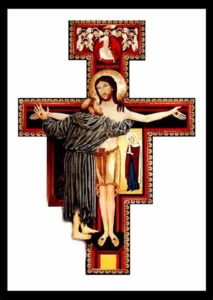 This image is an image worthy of our contemplation. It is a true expression of both Jesus’ and Francis’ fervent style of love. In Francis’ wounded hand, in turn, we see the loving response of St. Francis to the burning love of God, who first loved us. The Franciscan Coat of Arms is a wonderful expression of the Franciscan (or Seraphic) style of love. Each element conveys key themes of humility, poverty, and unity with Christ, which are central to Franciscan spirituality.
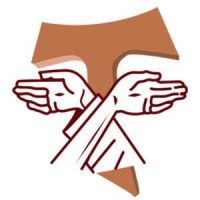 It features two crossed arms, the bare arm of Christ over the robed arm of Francis, bearing the mark of the wounds of Christ from the crucifixion and stigmata respectively. There is also a cross (Tau) in the background. Here is a breakdown of the symbolism:
-
Two Crossed Arms
 Bare Arm of Jesus: One arm, usually on the left, is bare and represents the arm of Jesus. It bears the nail wound from the crucifixion. This position crossing from the left to the right, highlights Christ as the guiding figure, the ultimate source of salvation and the direction for those following the Franciscan path. This symbolizes the ultimate act of divine love and self-sacrifice in the Paschal Mystery—the passion, death, and resurrection of Jesus. This arm reminds us of Christ’s humility, as “he emptied himself, taking the form of a servant” (Philippians 2:7-8).
Clothed Arm of St. Francis: The other arm, usually on the right, is clothed in the sleeve of a friar’s habit, representing St. Francis of Assisi. It is marked by the stigmata, and signifies the way Francis identified so closely with Christ. The clothed arm with the wound of the Stigmata symbolize a life conformed to the cross and committed to Christ’s humility, poverty, compassion and service. Together, the two arms symbolize the close bond between Christ and Francis and emphasize the ideal of imitating Christ fully, which is at the heart of Franciscan life.
-
The Cross
 At the center, the cross stands as a reminder of the centrality of Christ’s crucifixion and resurrection. It is a symbol of self-sacrifice, redemption, and the love that both Christ and Francis had for all creation. The cross emphasizes the Franciscans’ devotion to following in the footsteps of Christ, particularly in embracing the hardships and humility that come with a life dedicated to serving God and others.